A name, a logo and five pages. The most valuable part was what we took out.
A name, a logo and five pages. The most valuable part was what we took out.
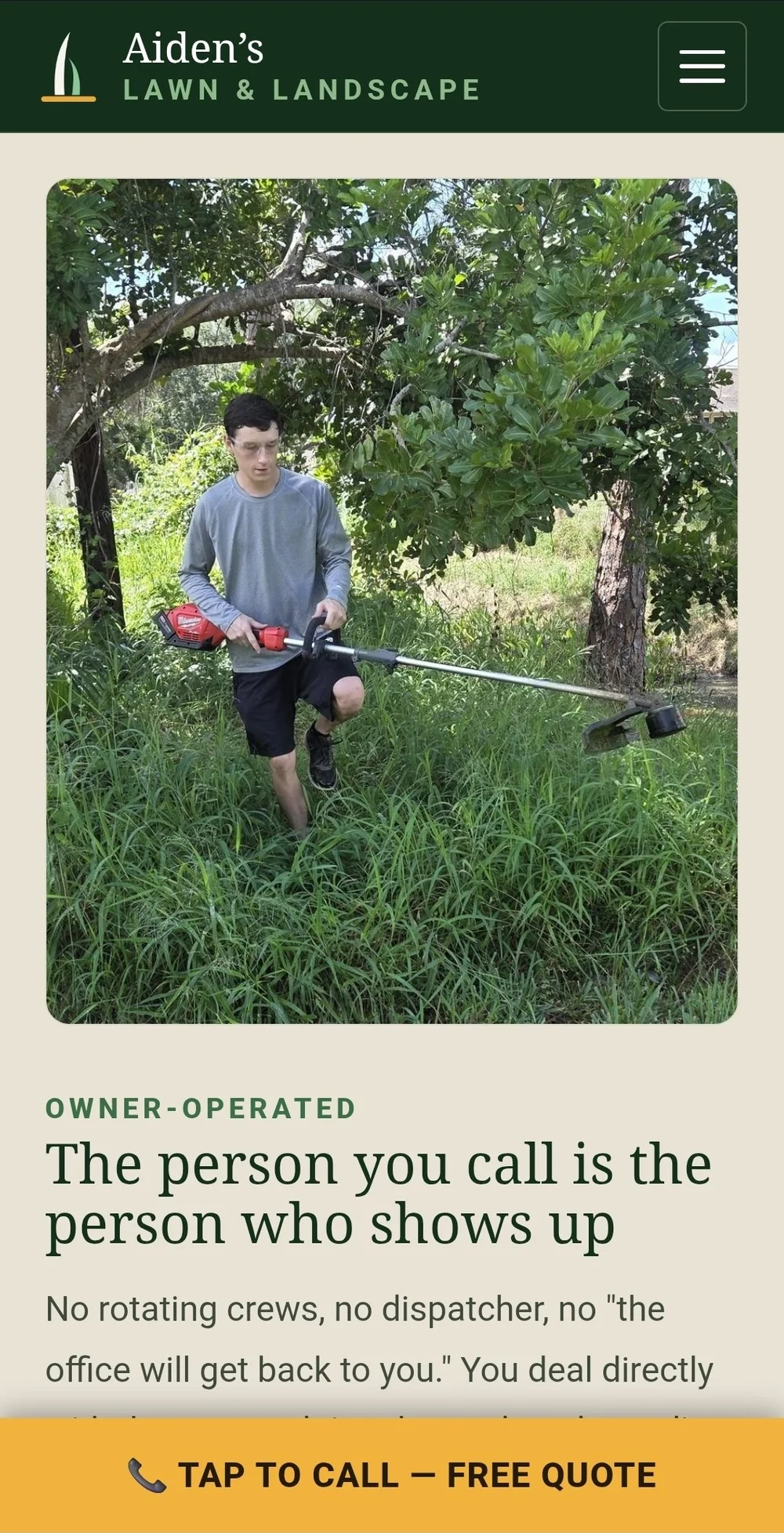
A young man in Sebastian was cutting yards in the mornings before his shift at another job. No business name, no website, no Google listing. This is what we built — and the four questions I asked that changed what went on the site. Two of them took something off the site.

He came to me with a weed-eater, his young son, and the start of a customer list. He left with a name that clears the state registry, a logo whose story he can tell in one sentence, a five-page site, and published prices no competitor in his market offers. The research came first, and it changed the whole strategy before anything was designed.
| The client | The situation |
|---|---|
| Who | A new lawn and landscape operator in Sebastian, Florida. One man, a weed-eater, and his young son helping. |
| Already had | The start of a customer list and a willingness to do the jobs other crews turn down. No name, no logo, no website, no listing. |
| The problem | Nothing to point anyone at, and the name he wanted was already registered three times over in Florida. |
| What was done | Name research against the state registry, a logo, five pages, published prices from $75, and the whole business positioned around the job everyone else says no to. |
- The condition I set before I'd start
- What the research found, and why it changed everything
- The name he wanted was already taken three times
- A logo he can explain in one sentence
- Five pages, and the one that matters most
- ★ The four questions that changed the site
- Publishing prices when nobody else will
- What the first month of data says
- Questions people ask about this
The condition I set before I'd start
I offered to build it free. But not unconditionally.
The deal was: come up with a name, do the research, and buy the domain yourself. Then I'll build it.
That condition did more work than it looks like. It's a filter. Someone who won't spend an evening on their own business name won't send you photos, won't answer questions, and won't keep the site current after launch.
He came back with a written brief — positioning, a fourteen-item service list, a proposed structure, About copy in his own words, an FAQ, and notes on his Google listing.
The pattern I'd bet on: what a client does in the first 48 hours predicts the entire project. Ask for something small before you give something big. It costs you nothing and it tells you everything.
What the research found, and why it changed everything
Nothing got designed until I knew what he was up against. I went through every lawn care business showing up in Sebastian — ratings, reviews, websites, what they claimed to do.
The finding that changed the strategy
Page one of Google for "lawn care Sebastian FL" is not local businesses. It's lead-generation aggregators — the national platforms that sell your name back to you as a shared lead. They outrank nearly every local operator.
You do not beat a national platform on organic search with a five-page site for a one-man operation. So we stopped trying.
The strategy became: the Google Business Profile and the map pack are where the calls come from. The website exists to feed the profile and convert the clicks it sends.
Aggregators don't appear in the local three-pack. That's the winnable ground, and it's a completely different job from the one we would have done if we'd started with a homepage design. I've written separately about why those platforms are so hard to outrank.
What the bad reviews told us
I read every one-star review in the market. Not for gossip — for positioning.
They all said the same three things: didn't call back, didn't do what he said, left a mess.
Every one-star review in a local market is a free positioning brief, written by your competition. Nobody complains about logos. They complain about being ignored and being let down. Build the brand to answer the complaints and you're selling the thing the market has already told you it's missing.
Two more gaps: most competitors had weak or no real website, and nobody was claiming overgrown-property rescue. Every one of them sold generic "lawn care." Not one spoke to the person whose yard had gotten away from them.
The name he wanted was already taken three times
His working name put "Sebastian" in front of "Lawn & Landscape." Reasonable instinct — put the town in the name.
I ran it through Sunbiz, Florida's business registry, before he filed anything. Three active registrations came back using the same words, plus a business already operating locally with the same words in a different order.
That name was saturated. Filing into it would have meant permanent confusion — on Google, in the registry, and in customers' heads.
What we chose instead
Aiden's Lawn & Landscape, named after his son.
It's distinct
Nothing like it on the registry. He can file it, own it, and rank for it without competing against three near-identical names.
It signals owner-operated
Which is exactly the trust signal every bad review in that market was begging for.
It's a story he can tell in one sentence
Stories travel in a small town in a way slogans never do.
The obvious worry: doesn't dropping "Sebastian" hurt local SEO? No. Local ranking comes from the Google Business Profile address, the service area, and the town appearing in the site's content — not from the business name. The category and services fields do that work, and a keyword-stuffed business name is against Google's guidelines anyway.
A logo he can explain in one sentence
Three concepts, each with an argument rather than just a look. The one he chose: two grass blades rising from a single clean amber cut line. One tall, one small.
The blades are him and his son. The amber line is the clean edge he cuts. Three elements, all of them meaning something.
It won because of one sentence he can say to a homeowner: "the two blades are me and my son."
A customer repeats that. Nobody repeats an abstract mark. In a town where work comes by word of mouth, a logo that explains itself out loud is doing sales work that a better-looking logo wouldn't.
It also had to survive being small. It reads at 16 pixels, works reversed on a truck door, and holds up as a round Google avatar — which is where most people will see it first. A second concept scored higher on story but collapsed below 32px, so it became a motif inside the site instead of the mark.
He got the full kit: SVG masters in color, reverse and single-color black for vinyl cutters and embroidery, PNGs at every size, the Google avatar, favicons, and a one-page brand card with the rules written down.
Five pages, and the one that matters most
| Page | The job it does |
|---|---|
| Home | Positioning, proof, and a path to every service |
| Services & Prices | The published price menu — the differentiator |
| Overgrown Yard Cleanup | Owns the keyword nobody claimed |
| About | The son's-name story, and owner-operated trust |
| Contact | Form, click-to-call, photo upload |
One constraint shaped the whole design
Sebastian skews elderly. So the site was built to a senior-readability standard: body text at 17px with generous line spacing, large tap targets, and nothing anywhere below 14px.
Competitor sites in that market run small default type. This one can be read without hunting for glasses — which sounds like a detail until you remember who's calling.
The strategic page
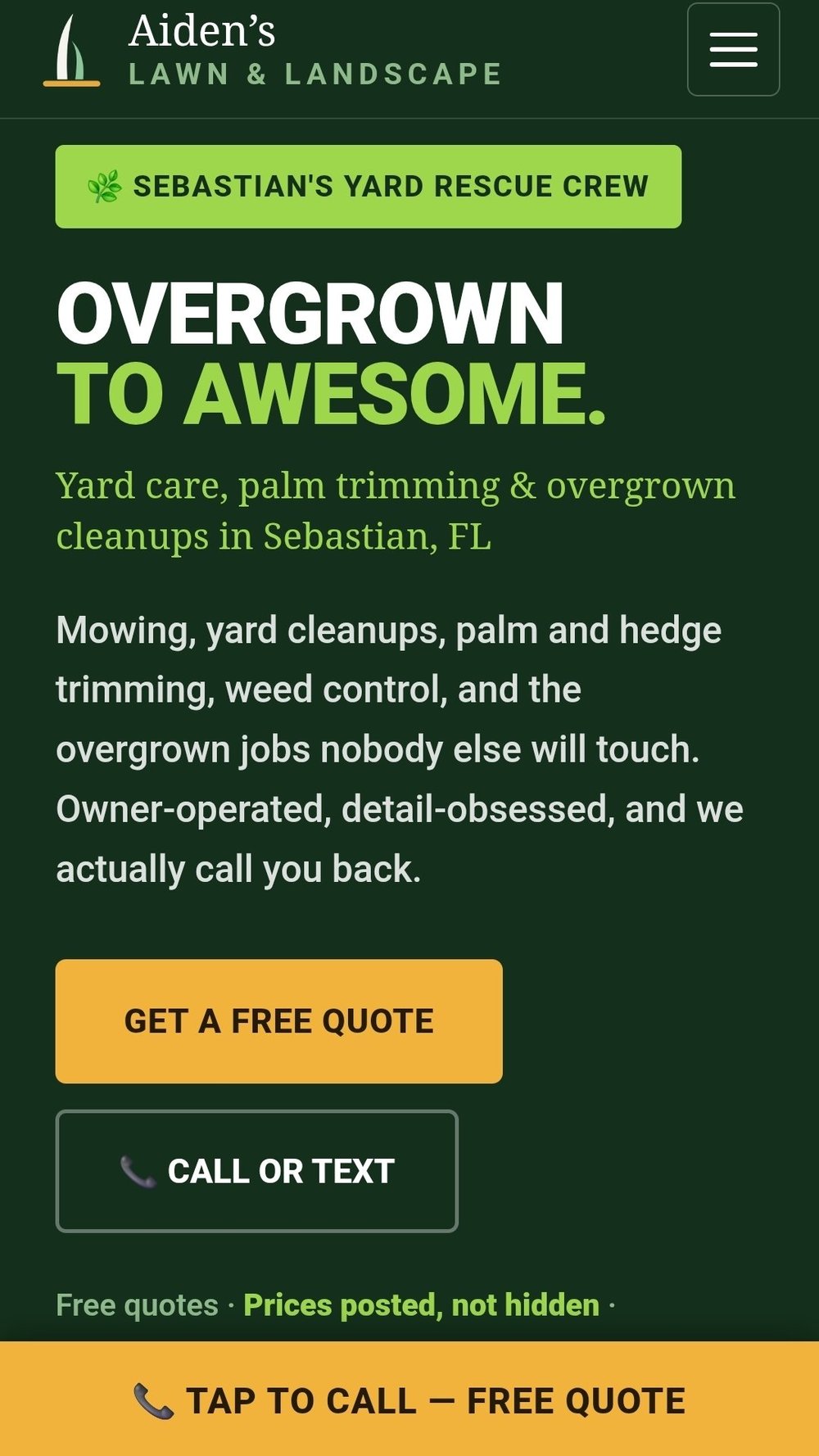
The cleanup page targets the keyword nobody had claimed, and it's built around situations instead of services: it got away from you · you just took over a property · you got a letter from the city · storm season left a mess · someone else turned you down · a vacant lot or a business property.
Nobody searches for "landscape bed remediation." They search for their embarrassing situation.
The hero on that page says "no judgment, ever" — because shame is the real reason people put off calling about an overgrown yard, and no competitor was saying it. And the contact page asks for a photo instead of a description, because someone in that position doesn't know the industry word for what they need.
★ The four questions that changed the site
This is the part worth reading, because it's what the work is actually for.
I ask every client the same four questions before anything goes live. On this build, two answers took something off the site, one corrected a number, and one softened a promise.
| The question | Why it has to be asked |
|---|---|
| "Is the entity actually filed?" | Drafts pick up a business structure the client hasn't registered yet — it lands on every page and inside the schema markup, where nobody thinks to look. Claiming one you don't hold is a real misrepresentation, so it comes out until the paperwork exists. I recommend filing regardless: it's inexpensive, and it protects personal assets when you're running equipment on someone else's property. |
| "Do you own the equipment for everything listed?" | One service on the draft list wasn't something he could deliver yet. Advertising a service you can't perform is the exact complaint sitting in the market's worst review. It came off the site entirely, and it goes back the day the equipment arrives — a ten-minute edit. |
| "Can you do it at that price and still make money?" | The draft carried a starting price that didn't match his real numbers — and it was wrong on his highest-value page, where a customer would have arrived expecting one figure and been quoted a higher one. That's a bait-and-switch feeling on the first contact with a brand-new business. Replaced with his real published numbers. |
| "Can you keep that promise on your worst day?" | The site promised same-day response in five separate places. His actual schedule couldn't support it. Softened to "usually within a day" and "every message gets a reply" — still a real differentiator against competitors who ghost people, but one he can keep. |
The through-line: every one of those was the website being more impressive than the business was ready to be. Closing that gap is the job.
Any one of them, left in, becomes the bad review that sinks a new business in a town where everyone talks. That is worth more than the design.
Publishing prices when nobody else will
The same principle turns up in a clinic rebuild, where naming the conditions she treated produced bookings for a service she had offered for years and never advertised properly. And in a painting company's rebuild, where the highest-value fix was correcting one digit in a phone link.
Not one competitor in that market publishes a single price. Not one.
His brand promise was already "clear, honest pricing, no surprises." So rather than claim it, the services page proves it — a full menu, real numbers, every service he offers.
The headline says it plainly: "Most lawn companies won't show you a price. We will."
It does three things at once. It proves the brand promise instead of asserting it. It pre-qualifies callers, so a man with limited hours isn't spending them on people who were never going to book. And it spares the customer from having to call just to learn what something costs.
The customer nobody was talking to
Buried in his own description of one-time cleanups was a list: rentals, move-ins and move-outs, HOA cleanup, preparing a property for sale.
That's landlords, realtors and HOA managers — repeat customers with deadlines and no emotional attachment to price. Not one competitor was speaking to them. It became its own section on the services page.
That's what the research is for. It wasn't in the brief; it was in his own words about a service he already offered.
What the first month of data says
Everything below was measured on September 27, 2026, four weeks after the site went live. Search figures come from Google Search Console for aidenslawnandlandscape.com. Profile figures come from the Google Business Profile manager. Nothing here is estimated, and where a number is too small to lean on, I say so.
| Window | Clicks | Impressions | CTR | Average position |
|---|---|---|---|---|
| Aug 24 – Sep 18 | 6 | 111 | 5.4% | 55.2 |
| Aug 24 – Sep 25 | 9 | 145 | 6.2% | 44.0 |
| Aug 29 – Sep 25 (28 days) | 9 | 116 | 7.8% | 43.2 |
| Sep 19 – 25 (7 days) | 3 | 34 | 8.8% | 7.3 |
Average position 55 is page five or six, which is the same as not being there at all. Position 7.3 is page one. That moved inside a single week, and the week it moved was the week the first town page went live.
Read this before you take the number seriously. Position 7.3 is seven days on 34 impressions. That is a small sample and small samples move. The rolling three-month average is still 44, because the earlier weeks drag it. The nine clicks cannot be credited to any search term either: Google withholds rare queries, so every query it names shows zero clicks and all nine sit in the anonymized bucket. And one project cannot prove causation. The town page went live the same week the position changed, which is suggestive and nothing more. I will report the next week whichever way it goes.
The problem the town page was built to fix
The first look inside Search Console said something specific and unflattering: the site was being shown to the wrong towns. The biggest queries by impressions were overgrown property cleanup in Titusville, leaf removal in Ponce Inlet, lawn care in Lighthouse Point and yard cleanup in Middleburg. Some of those are hours away. Across the three queries that were genuinely local, there were five impressions in total. The service pages were working. The geography signal was missing.
So I built one page for Barefoot Bay and Micco, not two. They are the same census area, and two pages would have been near-duplicates of each other. The page is built on figures anyone can check: Micco is 61.4% aged 65 or over against Sebastian's 36.8%, owner-occupied housing is 91.9%, and under 5% of the population is school age. Nobody in that house is cutting their own grass. Where the data does not exist, the page says so: Barefoot Bay is not a Census geography, so the numbers are Micco's and the page states that rather than pretending otherwise.
Google found and indexed it on its own inside seven days, with no manual request. It picked up its first impressions in week one and now appears in a brand search for the business.
The Google Business Profile, two weeks apart
| September 14 | September 27 | |
|---|---|---|
| Reviews | None | 2, both five stars, both replied to |
| Services with a published price | 0 | 21 |
| Photos | None | 11, plus cover photo and logo |
| Profile views in search | 19 | 23 |
| Customer interactions | 2 | 4 |
| Duplicate listing on Maps | Present, and also verified | Removed |
Twenty-one priced services is the part worth writing about. No competitor in Sebastian publishes a single price, so the profile now delivers the promise the business makes rather than claiming it. It also filters out the tire-kickers, which matters for one man working three days a week. The duplicate listing mattered for a different reason: both copies were verified, and that is an account-level risk, not just a confusing search result.
The two reviews, in full:
“Aiden is amazing. He listened to every concern I had about my yard & executed well on his first time mowing my lawn.” — Lacresha Mortimer Wright, Google review, September 2026
“Showed up on time. Delivered on promised cut.” — Deborah Weber-Ely, Google review, September 2026
What I am not claiming
Nine clicks is nine clicks. It is not traffic, and anyone reading this should see that I know the difference. There is no revenue figure here because I do not have one; if Ronnie tells me what the profile produced in booked work, that becomes the strongest number in the piece, and until then it stays out. All of these figures are as of September 27, 2026, and they will move.
Questions people ask about this
How long did the whole thing take?
The research, name check, logo concepts, five pages, schema and share images were built over a short, focused stretch of work. But calendar time depends almost entirely on the client, because the build waits on their photos, their prices and their answers. That is why I quote a delivery window rather than a number of days.
Why check the state business registry before choosing a name?
Because it takes five minutes and it prevents a permanent problem. On this build the name the client wanted returned three active registrations using the same words, plus a business already operating locally with those words in a different order. Filing into that means permanent confusion in search results, in the registry and in customers' heads. Check Sunbiz in Florida, or your own state's registry, before anyone falls in love with a name.
Does leaving the town out of your business name hurt local SEO?
No. Local ranking comes from your Google Business Profile address, your service area, your primary category and the town appearing in your website content. It does not come from the business name. Stuffing a town or a keyword into your registered name is also against Google's guidelines and is one of the documented causes of profile suspension.
Why publish prices when competitors hide them?
Three reasons. It proves a brand promise about honest pricing instead of just claiming it. It pre-qualifies callers, so a small operator with limited hours is not spending them on people who were never going to book. And it removes the friction of having to call just to find out what something costs. In a market where every competitor says "call for pricing", a published menu is both a differentiator and a filter.
What are the four questions you ask every client?
Is the entity actually filed. Do you own the equipment for everything listed. Can you do it at that price and still make money. And can you keep that response promise on your worst day. On this build all four answers changed what went live: two took something off the site, one corrected a number, and one softened a promise. Any one of them left in becomes the bad review that sinks a new business.
Do you build sites for free?
Not normally. This one was a deliberate exception for someone starting from nothing, and it came with a condition: he had to choose the name, do the research and buy the domain himself before I started. My published prices are on the site, and most businesses need the three-hundred-dollar Google listing fix rather than a new website.
Starting a business in Sebastian? Check the name first.
Send me the name you're considering and I'll run it through the state registry and tell you who's already ranking for it. Free, ten minutes, and it's the cheapest mistake you'll ever avoid.